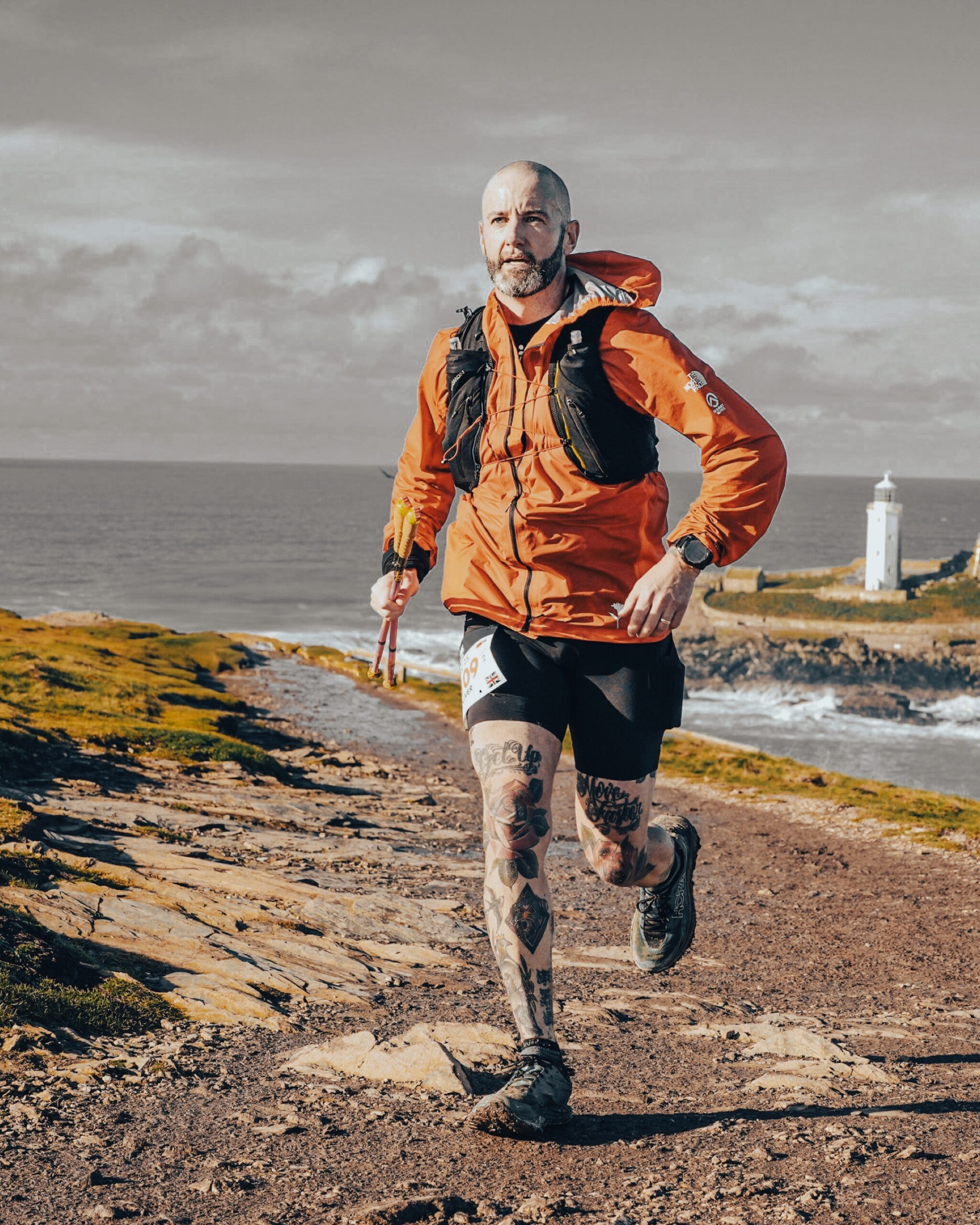
The ARC 25, a 42km run along the North Cornish coast, was my first UTMB event. I wanted to run it to get a glimpse and taste of the full course, a 100-mile beast around the tip of Cornwall. The race has fascinated me for some time, being known as one of the UK’s toughest. As well as over 5,300m of elevation gain, the 100-miler takes in some of the gnarliest Cornish coastal paths (if you can call them that), over rocks, dunes and through crashing waves. Add into that the typical January weather for Cornwall, not to mention the limited daylight hours, and the race is certainly one of the most brutal going.
Anyhow, the 25 is the final quarter of that route and takes place on the Sunday, once all the 100 and 50 runners have come in over the previous 24 hours or so. The weather for those runners was nothing short of biblical (I was camping in the South West at the time, so I felt it!). I have no idea how any of them finished. It’s truly remarkable.
Come Sunday though, it was a different story. The sun appeared, the winds dropped and before I knew it, I was regretting all the cold weather gear I had packed, with nothing appropriate to wear in these now mild conditions. Fuck.
I’d decided to use this race as an opportunity to test some MDS food too, taking on a freeze-dried spaghetti bolognese the night before for 1,000 kcal and, in the morning, a similar packet of granola for another 1,000 kcal. On reflection, that was totally overkill and what ensued was not great. By the time I got to the start line, I felt a bit nauseous and that was to be the case for the next six hours, alas.
Once we got going, it was clear I’d overeaten and my tummy was all over the place. Added to that, as soon as we started running, it became obvious I was extremely hot and my heart rate was spiking. I had gone out pretty fast for a trail marathon, which didn’t help, but it was part of my strategy, knowing that the final third of the course featured some killer elevation that I’d have to be hiking both up and down due to the gradients. So I stripped off one layer and my hat, to little avail, and pushed on. Unable to take on any additional food or get drink down me, this effort over the first 20km (1hr 50) was about to take its toll. I skipped the checkpoint, as I had barely drunk or eaten anything, and pushed on.
Between 20–30km, a bit more elevation kicked in and, after a couple of ascents, my tank was well and truly empty. I stripped off my only remaining layer, leaving me in a long-sleeve thermal base layer, and still I was too hot. I just couldn’t cool down for the life of me. I desperately tried to get some electrolytes down me but, with dizziness taking hold, I got my poles out and had to hike it into the final checkpoint. Maybe I was a little worse than I realised, as the paramedic helped me onto a seat and quickly shoved electrolytes and watermelon into my hands and there I stayed for almost 20 minutes, which sucked.
Once I felt marginally better and with a DNF just not an option, I grabbed my poles and set off, spending the next two hours hiking the final 10km of the race, with over 150 people pouring past me. Frustrating on many levels, but mainly because the trails were tight and muddy and having to move over for people became increasingly annoying. It was in these final 10km that I managed to do a bit of soul-searching, analysing the mistakes I had made that led to this disappointing end to the race.
- I ate too much pre-race, trying to overcompensate for the challenge ahead. I run better on small amounts of food and have never had issues eating during races before. No idea why I changed that for this.
- I didn’t pack for the unexpected. So when the sun came out and I stripped off all my layers, I was still in a long-sleeve, thick thermal top. It was inappropriate for the conditions.
- Although it was my strategy, given those two issues I ran the first half too fast, which amplified both my gut and heat issues. In hindsight, the final 10km was definitely more hiking terrain than running, so in some ways it did work, but the 20-minute sit-down at an aid station could likely have been avoided by managing a lower-effort pace in the first half.
Whilst I was kicking myself and eating humble pie in those final 10km, I realised I had made one superb decision. I brought poles with me and I’d trained with them. They paid dividends. I watched so many people struggle up steep ascents and descents, but with poles I was able to keep a relatively steady hiking effort. I’ve carried them in many races and have rarely used them, but always liked having them as a backup. This paid off big time.
With over 1,000 people running the ARC 25 that day, the experience is quite humbling when you realise what a mediocre runner you actually are. I struggled and the self-doubt about pursuing a running coaching side hustle definitely crept in. However, the reason I have so many races this year is not only to improve and push myself out of my comfort zone, but also to continue making mistakes and learning from them first-hand, so I can pass that knowledge on to others in the future. It’s like building a CV of race experiences and this was certainly another one to add to the books.
As a course, the ARC 25 really was beautiful. I didn’t hesitate to stop and take photos throughout, the nice bits, not the gnarly climbs where I was working my ass off. The views of the coast, the rolling dunes and the dramatic landscape were a pleasure to run (and hike) through. With bad weather, I can only imagine how tough that would be and how disinterested in the views I’d have been. There was an epic amount of mud we had to work through, over-the-ankle, fill-your-boots-style mud, so we didn’t have it completely easy. The chaotic slipping and sliding really takes it out of your energy stores and I did well to stay upright throughout. I easily saw over a dozen falls where people slipped over. In fact, I think that’s the first muddy race I haven’t floored it in, another win for the history books.
Comments are closed